Age-Friendly Health Systems
Join the movement to make your health system age-friendly
|| Also visit our Age-Friendly Care page for Older Adults and Family Caregivers ||
|| Also visit our Age-Friendly Care page for Older Adults and Family Caregivers ||
We all deserve safe, evidence-based health care focused on what matters to us as we get older. That's age-friendly care.
Age-Friendly Health Systems is an initiative of The John A. Hartford Foundation, the Institute for Healthcare Improvement and the American Hospital Association.
It's a movement helping hospitals, medical practices, retail pharmacy clinics, nursing homes, home-care providers and others deliver age-friendly care.
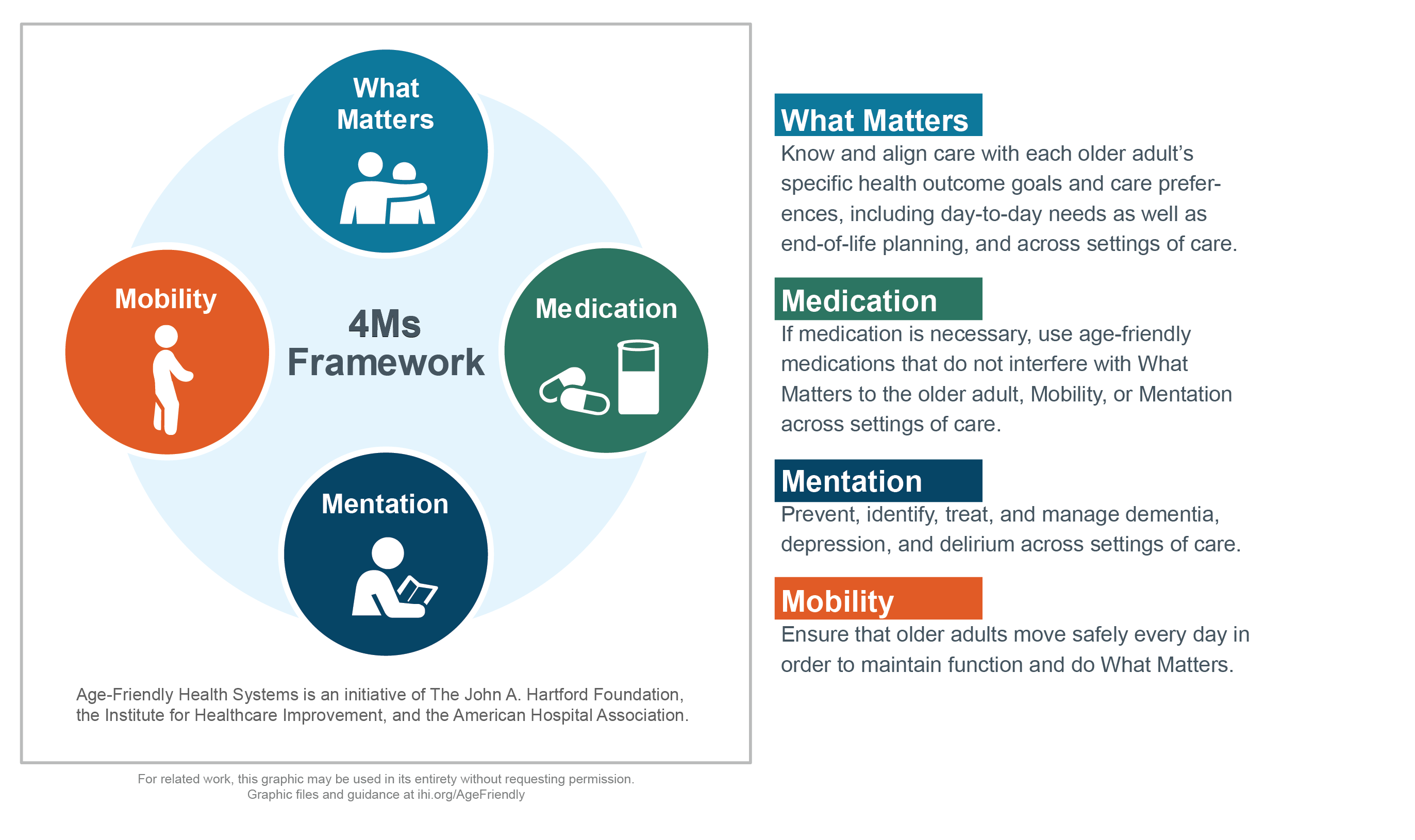
In an Age-Friendly Health System, value is optimized for all — patients, families, caregivers, health care providers, and the overall system.
Explore the Age Friendly Hospital Measure's Five Domains Attestations.
Hospitals can be successful in meeting this FY2025 measure by participating in the following programs:
Age-Friendly Health Systems (AFHS)
Health care teams can join a free, seven-month learning collaboratives to learn about, test and adopt the 4Ms Framework in their care setting.
The American Hospital Association (AHA) will facilitate the next Action Community beginning in fall 2026. Sign up and view other ways to join the movement.
Geriatric Emergency Department Accreditation (GEDA)
Emergency departments that meet standards for age-friendly ED care can receive accreditation from the American College of Emergency Physicians.
The related Geriatric Emergency Department Collaborative provides training and education on standards related to the GEDA program.
Geriatric Surgery Verification (GSV):
Hospitals that meet standards for age-friendly surgical care can be verified through this program of the American College of Surgeons.
Teams can learn more and access a webinar, case study, and more resources on how GSV can help your hospital improve care and comply with the new CMS measure.
Watch a short video - shown at the 2024 Home Care and Hospice Conference and Expo - on how better care for older adults starts with the 4Ms of Age-Friendly care: what Matters, Medication, Mentation and Mobility.
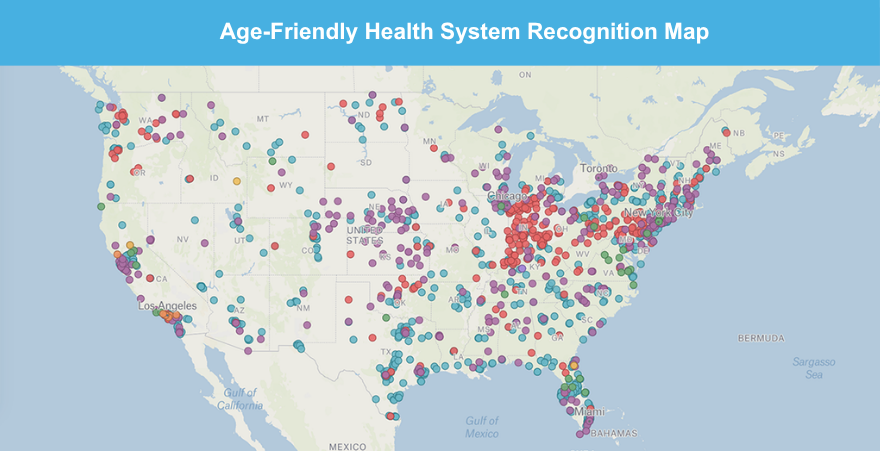
IHI has recognized 7,011 hospitals, practices and long-term care organizations as Age-Friendly Health Systems Participants and Committed to Care Excellence as of September 2026. A spreadsheet of all recognized Age-Friendly Health Systems across levels, including addresses, is available on the IHI website.
Age-Friendly Health Systems action communities, led by IHI and AHA, test the 4Ms Framework in hospital and ambulatory settings, sharing learnings in a virtual community.
Join the fall 2026 Action Community, which will be led by AHA.
More information on other ways to join the movement can be found at IHI.org/AgeFriendly.
For further IHI Age-Friendly Health Systems resources, go to IHI.org/AgeFriendly
For one page JAHF quick links, go to Age-Friendly Care Quick Links: Resources for Health Systems, EDs and Surgical Units
WebMD visits Madsen Health Center in Utah, a great example of an age-friendly care provider that considers all of the 4Ms to really understand the patient.
When providers ask about a patient’s goals, medications, memory and mobility, they feel heard, says nurse practitioner Sidney Hunt of MinuteClinic at CVS.
Arthur’s providers at the VA in Salt Lake City are working to get him back to his favorite pastime – fishing in Alaska.
Other articles include:
For more publications and news coverage, go to IHI's age-friendly resources page.